
IT WAS GOOD
And It Still Is.

Someone, somewhere in a moment of difficulty, looks up and says: God is testing me.
I understand the impulse. When the water rises and you’re standing waist-deep in December cold at 3 AM with a fever already forming and you have to get the horses to higher ground in the dark — you want the story to mean something. You want a reason. A ledger. A point.
But I keep returning to the same place: the testing framework breaks the moment you press it.
A test requires uncertainty. You test what you don’t already know. You run the experiment because you need the data. So when we say God is testing us, we are quietly describing a God who doesn’t know the answer — a God who needs to find out. And that God, the uncertain one, the curious one collecting results — that is not the God anyone is actually praying to. Of course, uncertainty and curiosity come from God-source as well, lending an inconceivable attribute to divinity (could be a whole discussion on its own).
Here is a simpler architecture I imagine.
You make something. You step back. You say: it is good.
That’s the whole transaction. The painting does not then spend its existence demonstrating its worthiness back to the painter. The painter already spoke. At the moment of making. The proof was never pending — it was declared.
If we are made in the image of a God who looked at that making and called it good, then our existence is already the evidence. Not our suffering. Not our endurance. Not the data we spend a lifetime collecting to submit at some later date to some unnamed office. We are here. Because we’re here. That is already the thing.
I have walked the Camino de Santiago four times and planning number five. And I’ll tell you something true about arriving in Santiago: it is almost always anticlimactic.
Not because it isn’t beautiful. Not because it isn’t worth walking toward. But because hopefully by the time you arrive, you understand that you were already doing the thing. Every dawn departure from a cold alley. Every stranger who became a companion across fourteen kilometers. Every blister, every rain, every conversation that went somewhere neither of you planned. The Camino was happening the whole time. Santiago is part of the walk — not the verdict on it.
We have organized our theology the way we organize anxious travel: eyes fixed on the destination as the place where meaning finally gets assigned. But meaning does not wait at the end. It moves with you. It is in the moving.
Last December the Molalla River flooded — the worst I’d seen on this land. The night before, four of us had collected sandbags and lined the walls, doing what people do when water is rising and you still believe you can reason with it. Nature had other plans. By 3 AM we were all in it — waist-deep in cold water in the dark, moving horses to higher ground. Emmanuelle, who owns the farm, carried most of what followed. The cleanup. The recovery. I cooked. I kept people fed while the work continued. We each showed up the way we knew how.
Was the flood a test? Or was the river doing what rivers do when the rain does not stop?
A few days ago Emmanuelle noticed fruit forming on trees she had always believed were ornamental. Dark purple leaves, dark plums
— she had assumed they were the kind that give beautiful blossoms and nothing more. The fruit isn’t ripe yet. But it’s coming. We think the flood may have brought sediment from the river, minerals the soil didn’t carry before. The trees responded to changed conditions.
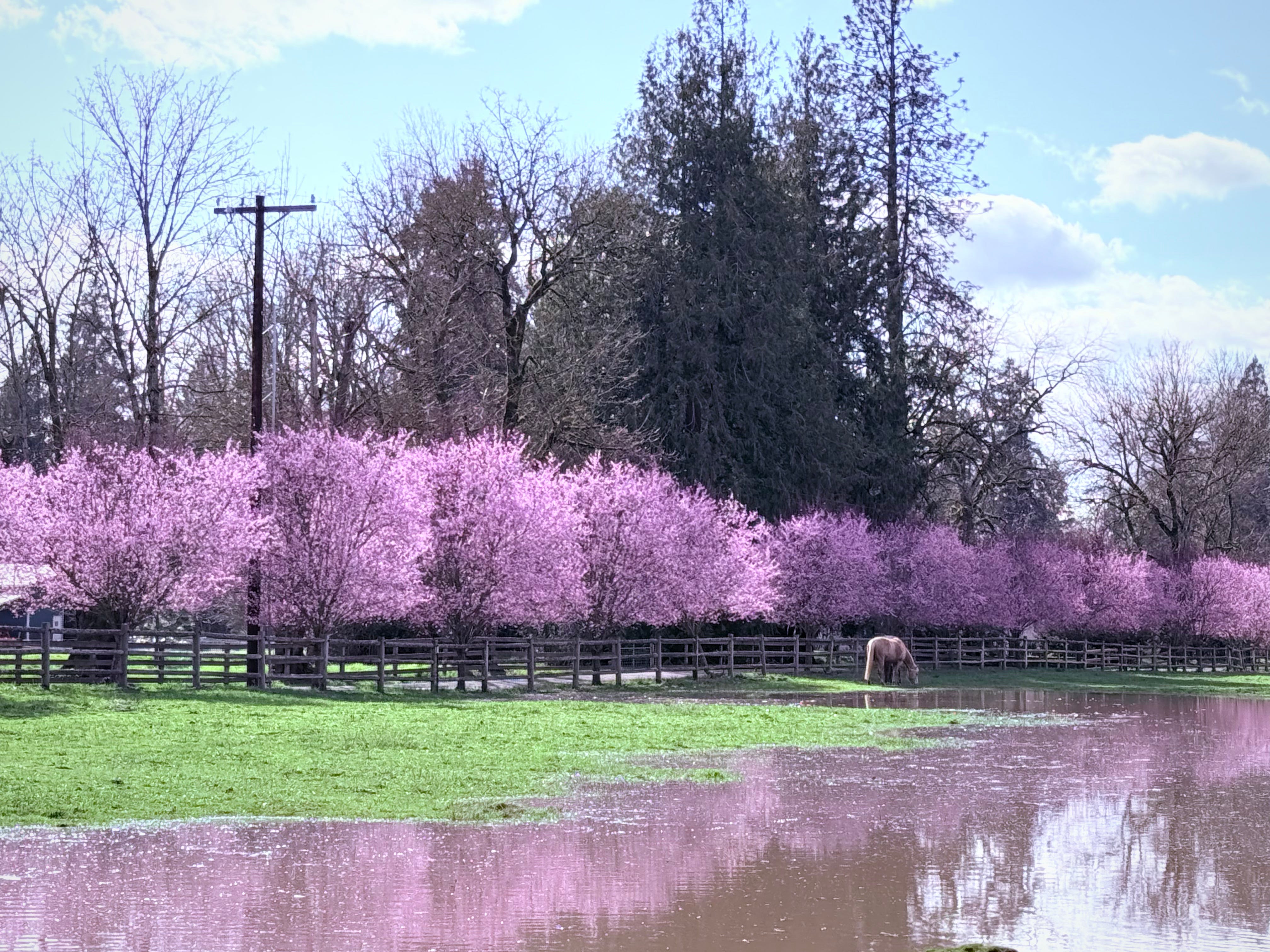
The fruit doesn’t know about the flood. It’s just coming.
Nature moving through its own intelligence, and four people who lined sandbags against a wall the night before, standing in an unexpected orchard months later, waiting on something sweet.
I want to know who built the other architecture. The one where we are perpetually on trial. Where every difficulty is a divine examination and every grace is a grade returned. Where an omniscient, loving, generative force — one that looked at its creation and called it good — somehow needs us to prove something back to it.
Someone constructed that. Someone decided the painting owed the painter a justification.
I’d genuinely like to know who.
And I’d like to know why we keep paying rent on it.